
Ed Sheeran Tour Fallout Tests Messina's Warning About Concert Industry Venue Power
Just two weeks after promoter Louis Messina warned a federal court that control of critical concert venues can give their…

Just two weeks after promoter Louis Messina warned a federal court that control of critical concert venues can give their operators enormous leverage over artists and rival promoters, the same basic pressure point surfaced on one of his own biggest tours.
Multiple stadium operators told Messina Touring Group that Ed Sheeran’s remaining U.S. stadium concerts would not be allowed to proceed if Macklemore remained on the lineup. Rather than risk losing the venues and canceling shows for hundreds of thousands of fans, MTG removed Macklemore from the tour.
The circumstances are different in many ways from those described in Messina’s recent antitrust filing against Live Nation’s proposed settlement with the Justice Department. The stadiums involved in the Sheeran dispute are not the Live Nation amphitheaters Messina accused the company of using to disadvantage his promotion business, and there is currently no evidence establishing that Live Nation coordinated or caused the stadium ultimatum.
But a report published Saturday by The American Prospect has added an unresolved question to the controversy: Why did an organized campaign seeking Macklemore’s removal specifically direct supporters to pressure Live Nation when Live Nation was not promoting the tour?
TicketNews has asked Live Nation/Ticketmaster, Messina Touring Group/AEG Presents and the Israeli-American Council about communications surrounding Macklemore’s removal and why Live Nation was identified as a target of the campaign. No responses had been received as of publication time.
The questions arrive as Sheeran is scheduled to return to the stage Saturday at Philadelphia’s Lincoln Financial Field for the first U.S. concert since Macklemore’s removal and the subsequent withdrawal of the tour’s other support acts.
Messina Filed Venue-Power Warning as Controversy Began
The timing is striking.
Messina submitted his Tunney Act comments concerning the proposed Live Nation-Ticketmaster antitrust settlement on Sept. 4, the same day Macklemore played the first of two Loop Tour shows at MetLife Stadium in New Jersey.
In that filing, Messina alleged that Live Nation stopped returning his calls in 2024 when he attempted to route several artists through the company’s amphitheaters. He cited difficulties involving Old Dominion, The Lumineers, Shawn Mendes and Mumford & Sons and argued that promoters cannot meaningfully compete for certain tours without access to the venues needed to build them.
“If Live Nation prohibits artists from using me to promote their amphitheater shows, I cannot compete,” Messina wrote.
Messina’s allegations have not been independently established by the court, and Live Nation has broadly rejected criticism of the settlement from AEG and other competitors. But his filing put the practical consequences of venue control at the center of his argument: An artist may theoretically be free to choose a promoter, but that choice becomes far less meaningful if working with that promoter makes essential venues unavailable.
Days after the filing, Messina confronted a different version of that problem.
MTG said venues hosting Sheeran’s upcoming U.S. dates had notified the promoter that they would not permit concerts to take place with Macklemore on the lineup. Losing those buildings would have threatened the remaining stadium leg of the tour.
What remains disputed is how all of those venues arrived at their positions.
Kraft Acknowledged Outreach but Disputed Coordinating Ultimatum
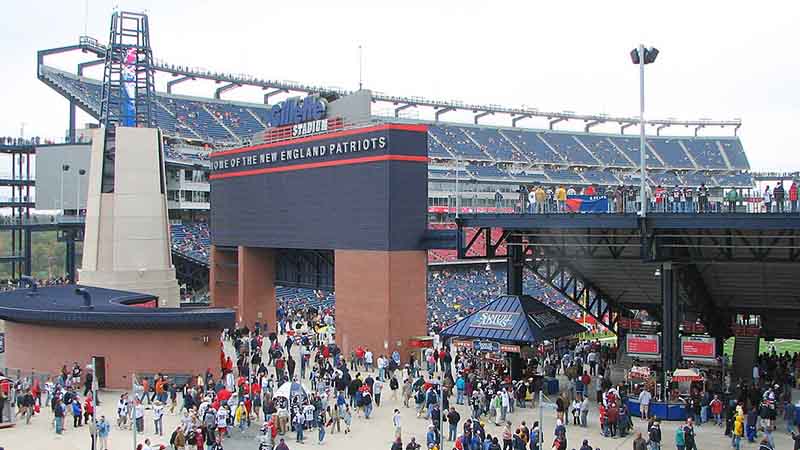
Macklemore has said Sheeran told him that New England Patriots owner Robert Kraft, whose Kraft Group owns Gillette Stadium, objected to his participation and rallied other stadium operators behind a common position.
The Kraft Group has disputed that account.
Kraft acknowledged contacting Sheeran personally to object to Macklemore appearing at Gillette Stadium and acknowledged communicating with the owner and manager of another stadium about his concerns. But he denied threatening to cancel Sheeran’s Gillette shows or organizing the broader multi-stadium ultimatum.
Messina Touring Group has confirmed the existence of the venue threats without publicly identifying how they originated or whether the affected venues coordinated with one another.
Sheeran subsequently said he spent days speaking with venues — including Kraft — in an effort to find a compromise. He said Macklemore’s removal was ultimately the promoter’s decision because Macklemore’s tour agreement was with Messina Touring Group rather than Sheeran personally.
That left one central point undisputed: enough venues were prepared to withhold access to their buildings that keeping Macklemore on the tour risked canceling the concerts.
The identities and motives of the actors are different from those in Messina’s antitrust filing. The underlying source of leverage — access to venues the tour could not readily replace — is remarkably similar.
IAC Campaign Specifically Targeted Live Nation
The American Prospect report adds another layer.
Following Macklemore’s first MetLife performance on Sept. 4, the Israeli-American Council launched a campaign seeking his removal from Sheeran’s remaining dates. Macklemore had used portions of his opening set to advocate for Palestinians and performed “Hind’s Hall,” his protest song associated with the pro-Palestinian campus movement.
The IAC objected to the performance and on Sept. 5 posted a call to action encouraging supporters to sign a petition asking Sheeran and Loop Tour leadership to remove Macklemore.
Its next instruction was more curious: “Contact Live Nation.”
The IAC told supporters to send their message to what it described as one of the world’s leading concert promoters and ticketing companies. A preserved copy of the New Jersey IAC post shows both instructions.


Live Nation, however, was not Sheeran’s U.S. tour promoter.
That role belongs to Messina Touring Group, which operates in partnership with AEG Presents. The IAC was apparently aware of the distinction: according to Prospect, its petition itself identified Messina among the relevant tour leadership.
Live Nation nevertheless has a commercial connection to most of the affected shows through subsidiary Ticketmaster. TicketNews previously found Ticketmaster listed as the primary ticketing provider for seven of the eight remaining stadium concerts from which Macklemore was removed, with SeatGeek handling the AT&T Stadium date.
That provides one reason for Live Nation to appear somewhere in the dispute, particularly as fans subsequently began seeking refunds. It does not by itself explain why the company was presented as an organization capable of acting on demands to remove an artist.
Prospect Asked About Live Nation’s Role
The Prospect said it asked Live Nation whether the company had approved or known about the IAC’s effort to direct supporters toward it, participated in the stadiums’ negotiations with Messina and Sheeran, restricted Macklemore from Live Nation venues or consulted with organizations associated with Kraft on questions surrounding artist speech.
According to Prospect, Live Nation directed the publication to Messina and did not answer those follow-up questions. The IAC also declined to provide the publication with an official comment.
Prospect goes considerably further in its analysis, arguing that Live Nation’s market power offers a likely explanation for how the stadium owners arrived at a common position.
The currently available record does not establish that conclusion.
TicketNews has found no evidence showing that Live Nation instructed the stadiums to reject Macklemore, coordinated their positions, threatened any participant or otherwise participated in the decision that ultimately removed him.
TicketNews therefore independently asked Live Nation and Ticketmaster whether either company communicated with the IAC, Kraft or the Kraft Group, any of the affected stadiums, Messina Touring Group or Sheeran’s representatives concerning Macklemore.
TicketNews also asked the IAC why its Sept. 5 campaign specifically directed supporters toward Live Nation; whether it communicated with Live Nation or Ticketmaster before or after issuing that instruction; and whether it asked Live Nation, Ticketmaster or any stadium operator to encourage other venues to take the same position.
Messina Touring Group and AEG Presents were separately asked whether Live Nation or Ticketmaster had any role in communications leading to the venue ultimatum, whether any stadium identified an outside party as involved in coordinating its position, and whether Messina considers the episode illustrative of the broader venue-access problem raised in his Tunney Act filing.
None of the three parties had provided an on-record response as of publication time. TicketNews will update this story if additional information is provided.
Venue Access Became the Deciding Factor
Whatever ultimately emerges about the communications behind the scenes, the consequences of the stadium owners’ position are already clear.
The promoter had contractual control over whether Macklemore remained on the tour, but that control operated within the practical limits imposed by access to venues.
Keeping Macklemore risked losing multiple stadium dates. Removing him preserved the concerts.
That is not evidence of a Live Nation role. It is, however, an unusually immediate illustration of the broader market dynamic Messina had just described to the federal court: control over venues can translate into influence over decisions elsewhere in the live-entertainment business.
The fallout has continued.
The tour’s other support acts subsequently withdrew, and Sheeran is returning to the stage in Philadelphia Saturday without the lineup originally sold to ticket buyers. TicketNews reported Friday that some Philadelphia customers had begun receiving refunds upon request, while the Massachusetts Attorney General’s Office had received at least 25 refund-related complaints concerning Sheeran’s upcoming Gillette Stadium concerts.
Resale inventory for several dates has also grown while ticket prices have softened in portions of the market. TicketNews has not found evidence establishing that the Macklemore controversy caused those movements, and some dates were already carrying substantial available inventory before the dispute erupted.
The Philadelphia concert remained scheduled for Saturday at Lincoln Financial Field.
For Messina, though, the episode has created an unusual collision between an antitrust argument and the mechanics of one of his own tours.
On Sept. 4, he told the federal court that a promoter’s ability to compete can become largely theoretical when another participant controls venues the artist needs.
Within days, his own ability to keep an artist on the Loop Tour became constrained by exactly that scarce resource: access to the buildings where the concerts were supposed to happen.
Who, if anyone, helped the stadium operators arrive at the same position remains an open question.
Read next
More headlines
Sep 18, 2026
Ed Sheeran Refunds Begin in Philadelphia as Softening Ticket Market Puts Pressure on Fans
UPDATE, Sept. 19: Ticketmaster has moved Saturday night’s Philadelphia Loop Tour concert from its previously listed 5:30 p.m. start to…

Sep 18, 2026
St. Pete Country Fest Adds StubHub as Official Resale Marketplace
StubHub has been named the Official Ticket Resale Partner of St. Pete Country Fest, giving fans an official secondary marketplace…

Sep 18, 2026
‘Spring Awakening’ Revival Reveals Complete Off-Broadway Cast
Complete principal casting has been announced for the upcoming Off-Broadway revival of “Spring Awakening,” directed by Tony Award winner Danya…